

The Christmas Siege
Louisa came fully awake, her instincts sending a jolt of energy through her body. She resisted the urge to move. Like a puppy seeking warmth from her littermates, she found herself wrapped around Eugénie’s midsection and her legs trapped in a tangle of limbs. The soft dueling snores of Joy and Virginie, who seemed to be taking turns inhaling and exhaling, were the only sounds.
She lay there for a moment, wondering what had stirred her from slumber when her stomach growled its irritation. The fierce stabbing pang threatened but failed to distract her from the immediate problem. Something was wrong.
No. Not wrong, just different.
The skill of watching and listening for the smallest change in her surroundings became innate after years of her uncle’s training. To miss the slight stirring of air generated when a door opened might mean the difference between spending your last days in prison or living to steal another day.
That tickle at the base of her neck persisted. What is it?
Resigned to her fate. She wiggled her way from under her friends’ arms and legs to poke her head out of the Clan of Dissipated’s cozy warren. The cold slapped her hard, and the air from her lungs solidified into fog, obscuring her vision. She stopped breathing long enough for her sight to adjust.
Moonlight leaked into the dorm room’s massive windows, casting long, rounded shadows away from the mounds of similar nests scattered around the freezing granite floor.
Built on a foundation of several layers of bunk-sized mattresses, more of the beds served as the walls, roof, and insulation, while sheets and blankets tied each structure together to form a small dome. Four or five girls slept in each, using their body warmth to get through the below-freezing nights.
Without coal or firewood to heat the furnaces, the kitchens were the only warm rooms in the school, and they were far too small to sleep the school’s remaining ninety students, all the nuns, and the handful of staff who had nowhere else to go.
It had been Eugénie who first built what she called an igloo. She had read about the design during a polar explorer’s recounting of his expedition’s attempt to find the Northwest Passage. She said the article included drawings of indigenous tribes’ Arctic homes. Eugénie made good on her promise that her creation would trap heat and keep out the cold just like those strange ice structures.
From the angle of the shadows, Louisa estimated it to be a little after midnight. With that revelation came her understanding of what had awakened her.
It’s Christmas Day. And it’s silent.
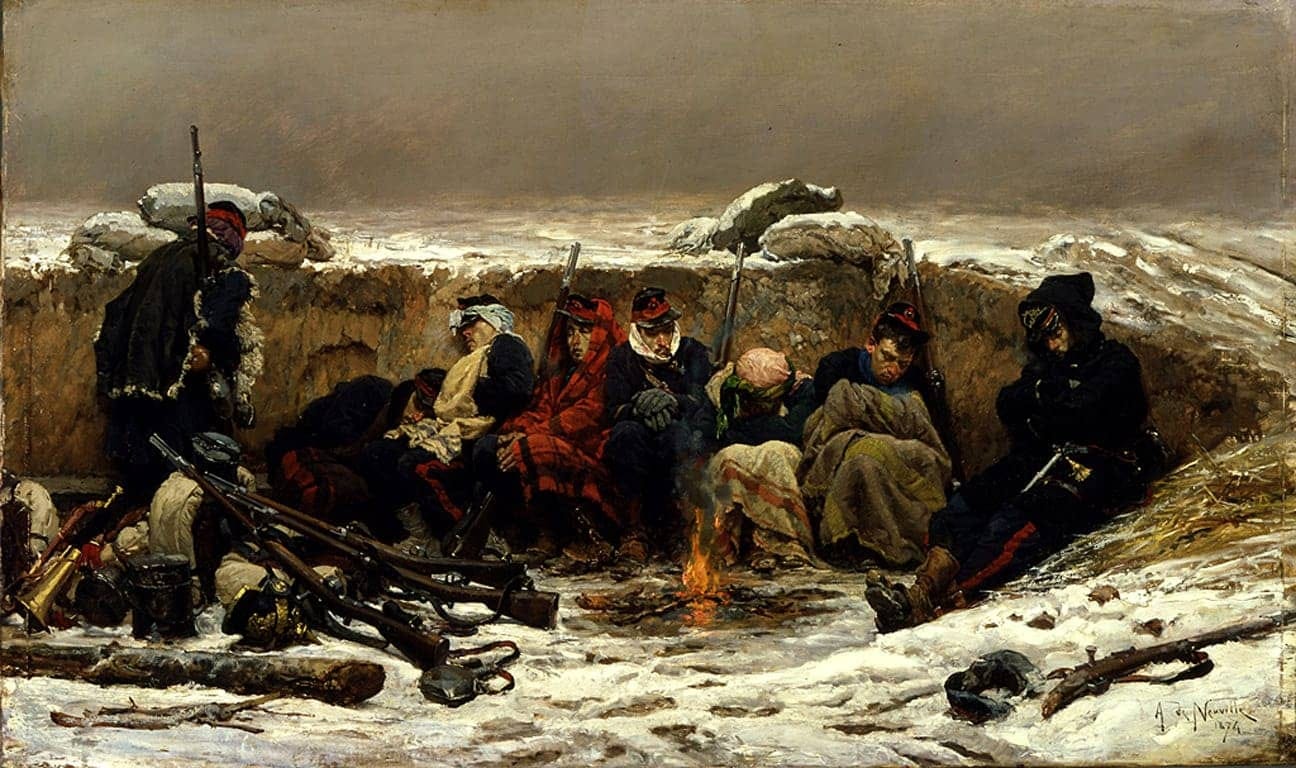
For the first time in the last week, the bombardment had stopped. Three days ago, not far from Fort de l’Est, which lay only two kilometers from the school, the French army attempted to break out of the Prussian siege, with disastrous results. The Prussians responded with a brutal, near-constant artillery barrage.
But now, the Prussian guns had stopped. And the French counter battery fire had also fallen silent.
Saddened, Louisa hated that it took one of the two most Holy of days to stop the senseless killing. Like she did multiple times a day, she prayed for an end to the war. To the siege. Then she made the sign of the cross but stopped short. With Mère de la Nativité’s constant scolding ringing in her head, she caught herself using the Greek Orthodox pattern.
Louisa had never given much thought to religion. Life posed too many worldly challenges for her to worry about the next one, and her needs were too immediate to wait for God to solve her problems. Thus, without reservation, she committed to doing things the French way, but thirteen years of habits were hard to break. She began again, and her hand crossed over her heart to finish over her right breast the way a good Catholic should.
“Christmas. It’s Christmas day,” Louisa whispered.
Bittersweet memories of this special day flooded back. Bitter because the children back home never let her go door to door with them to sing the Kalanta—Christmas Carols. They would say, “English girl, you’re not Greek. You can’t come.” After each song, she could hear them laughing and enjoying the treats the neighbors gave as they moved to the next house.
Her mother would wipe Louisa’s tears and give her a loving hug. Then they would sing the songs together as they danced around their house. And when they’d sung themselves hoarse, they’d enjoy the sweet treats her mother made for her. Even on her last Christmas, Louisa’s mother sang the Kalanta with her.
A sense of love flooded her chest as if her mother were with her now. Tears freezing on her cheeks, Louisa began to sing Kalanta Christougenna, low and clear. Note from the Author:I have included a Zoom choir rendition of the Greek traditional song for your enjoyment.
The other girls began to stir within the igloo.
Suzette’s voice echoed in the cavernous room, “Greek Bastard. If you don’t shut up, I’m going to punch you in the mouth.”
Louisa smirked as she finished the final line, pleased that she’d disturbed the bully. Then she yelled back, “Joyeux Noël, Suzette.”
A sense of purpose settled over her. Today, she would spread the joy of Christmas the way she had never been able to before, by singing the Kalanta for anyone who would hear.
A hand tugged on her arm, and she ducked back inside. The world went dark except for the small open chimney at the top of the dome.
Eugénie asked, “What were you singing?”
“A Greek chant de Noël. It is Jour de Noël.”
Joy said, “It was pretty.”
“Very,” Virginie said.
Her voice filled with enthusiasm, Louisa blurted out, “In the morning, I am going to go.” She didn’t exactly know how to express her thoughts in French, but she forged forward with what she knew. “Sing for the people and the troops.”
All fell silent, except for the girls breathing. Then all at once, Louisa heard. “That’s a fantastic idea,” “I want to go,” “We must go sing to the wounded.”
“Ssh,” Eugénie said. “Do you have a plan?”
___________________________________
Louisa pulled her shawl tighter around her shoulders. Eugénie, Virginie, and Joy sat shivering around the marble-topped refectory table, their breaths puffing gray like locomotives anxious to leave the station.
An unnaturally lean and somber Mère Sainte Adeline placed a bowl of thin broth on the table in front of Louisa.
“Eat before it gets cold.” She moved around the table, giving each girl a bowl.
Louisa leaned down to inspect her meal. A few cubed turnips and some unknown meat lay lonely and uninspired at the bottom of the bowl.
Joy said, “Yesterday afternoon, I saw the cook carrying in an armload of what looked like skinned rabbits.”
“They were too big to be rabbits. I’m pretty sure they were cats,” Virginie said, her eyes tight and her lips pressed into a line.
Eugénie sighed. “Be grateful. So many people out there have nothing but what they can get with their subsistence cards.”
“Rabbit. Cat.” Joy shrugged. “Better than the rat we were eating last week.”
Eugénie’s face blanched. “Never speak of it again. Even if we must.” She gulped. “Do it again. Never speak of it out loud.”
Louisa left her spoon on the table and raised the bowl to her mouth. She drank the broth, and for a moment, the dull ache in the pit of her stomach stopped complaining.
When all the liquid was gone, she set the bowl down. “Is anyone else going with us?”
Virginie swallowed. “Five more, and two others volunteered to run interference with the Mères.
“And Suzette?” Eugénie asked.
“She’s on laundry duty today,” Joy said with a half-full mouth.
Eugénie finished up the planning, “We meet at the cemetery at noon. We must be back by four.”
Louisa sought through her growing but still limited French vocabulary. “We go to the hospital invalids and then houses in Saint-Denis.”
The other girls nodded, and she picked up her spoon to savor the solid bits still in the bowl.
___________________________________
Among the iron crosses of the school’s walled-in cemetery, Louisa led the nine girls in practicing four French Christmas songs. Luckily for Louisa, Mère Saint Adeline held a choir class each day. It was the only time these days that Louisa saw the usually joyful nun smiling.
As the last refrain drifted away, Louisa turned to Eugénie. “We are ready.”
“We will each take a turn walking at the front. I’ll go first.” The tall, skinny leader of The Clan of the Dissipated waved. “Walk in my steps. That way you won’t get as tired.” She marched through the cemetery gate and trudged into a calf-high field of snow.
It didn’t take long before the cold sank into Louisa’s bones, but it could not deter her from her mission. To reach the field hospital, they had to march across a half-kilometer-wide blanket of snow. It felt daunting. When her turn came to take the lead, she threw back her shoulders and pushed through drifts that reached almost to her knees.
A single sentry, with what appeared to be amusement, watched them make their way over the last hundred meters. As they lined up in front of the man, he asked through a gap in the scarf wrapped around his head, “Demoiselles, what can I do for you?”
Eugénie looked to Louisa.
She stepped to the front, puffed up her chest, and said, “We have come to sing chants de Noël for the wounded.”
A frosted eyebrow shot upward. “I will need to ask my commander. Wait here.”
The man disappeared around the corner. When he returned, he came with a young officer with a straight back and piercing blue eyes.
“I am, Lieutenant Rousseau. Merci for coming. I’m sure your music will lift the men’s spirits. Follow me.” The you man turned on his heels and led them to the front of the building and through a dirt palisade built to protect it.
They moved through four layers of curtains made from blankets, each one bringing additional welcomed warmth. Upon entering a tall-ceilinged space that must have once been a warehouse, Louisa covered her mouth and nose. The stale air had the metallic taste of blood and an overwhelming smell of unwashed men. Then there were the moans and the not-so-soft cries of the wounded who lay on cots that were crammed from one wall to the next with barely a foot between rows for navigation.
Several of the girls behind her began to weep.
Virginie snapped, “Stop that. You are women of the Legion. If these men are brave enough to fight for us, we are brave enough to see their injuries without tears.” Soft cries wilted into sniffles. “Good. Louisa.”
Louisa turned to the Lieutenant and pointed to the small empty space to the side of the entrance. “May we stand there?”
He nodded and unwound his scarf to reveal a large burn scar covering the majority of his lower face.
Louisa turned from the grisly sight to usher the girls to their places. Then she began. She projected her voice, hoping to drive the suffering from the air as she sang a solo of the first verse of Cantique de Noël— O’ Holy Night. But for the cries of the inconsolable, the room fell still and quiet.
The rest of the girls picked up the second verse, and as they progressed, more and more of the men joined in singing. Note from Author— try as I might, I could not find a girls’ choir singing the song in French, so I found a soloist video for you.
At the end of the song, a soft cheer rose, and several men cried out, “Dieu merci!”
They followed with Il est né, le divin Enfant— He Is Born, the Divine Christ Child, Entre le bœuf et l’âne gris— Between the ox and the grey donkey, and they finished with Les anges dans nos campagnes—source behind Angels We Have Heard on High.
The room reverberated with the voices of every able man as they joined the girls in singing Gloria in excelsis Deo. No amount of bravery kept the tears from streaming down Louisa’s cheeks. So beautiful, she thought. So much more than the simple joy she had hoped to bring by singing the Kalanta.
Too choked up to speak, she nodded to the Lieutenant when they finished, and the soldier hurried them back outside. Cheers and clapping followed them into the cold.
Lieutenant Rousseau wiped his eyes and cleared his throat before addressing the girls. “That was magnificent. I would be remiss if I did not allow you to perform for General Carey de Bellemare.”
Eugénie held up a hand. “We will get in trouble if we go to the fort.”
The man’s burned cheeks turned his smile into a grimace, but there was humor in his blue eyes and in his voice as he said, “You will be in no danger. The general is currently having a parlay with his Prussian counterpart just outside of the fort.” He nodded to a horse-drawn wagon with his chin. “We will be quick. Climb up.”
The girls shared a look, and one by one they gave their silent agreement. Louisa was the last to climb into the blood-soaked wooden bed of the ambulance wagon. The driver slapped the reins, and the horses pulled them over the frozen road that had been kept clear of snow but not shell craters left by artillery fire. The girls huddled together for warmth. Each stared out at the broken landscape, caught up in her own thoughts.
Louisa reflected on what a special moment she had just participated in. On the power of Christmas. On the power of Faith. And finally, the power of music to uplift the soul.
As they neared the fort, hundreds of bundled-up soldiers lined the walls, staring out at the enemy. A few turned to see the strange sight of a wagon full of young girls coming their way.
Joy laughed, “The other girls will never believe us.”
Virginie chuckled. “They will when they find out it was Louisa who got us into this.”
Louisa felt a special chill as the horses clopped past the open gates of Fort de l’Est. They rode fifty meters into the contested land between the French and the Prussians before pulling up to a large makeshift tent.
Looking back, Louisa could see even more French faces looking now over the wall. Fifty meters to the front of the tent, a company of Prussian soldiers stood in perfect formation. Their hard spiked helmets and healthier complexions were the only things distinguishing them from the French soldiers on the battlement.
“Wait here.” The Lieutenant jumped down from his seat by the driver.
He marched to the tent and snapped a salute to the two sentries before he entered. A few minutes later, he returned with two older men on his heels and several attending officers following them. The French general was a large man with a full, black, bushy beard flecked with grey, while the much slighter Prussian officer’s simple gray beard contrasted with his still dark hair.
Louisa stood in the wagon bed and motioned for the other girls to do the same.
The French general said, “The lieutenant says that you have been to the hospital to sing chants de Noël to the wounded and that you lifted their spirits.” He placed his hand over his heart. “Demoiselles, merci du fond du cœur.” He lowered his hand and smiled. “Would you please grace us with the same?”
Louisa struggled for a moment to find the words, but then said, “We would be happy to.” She looked over her shoulder, and Virginie nodded that they were ready.
She once again began with a solo and led the girls through the same four songs. Slowly, the French soldiers around the tent joined in. Then here and there, a voice from the men in the fort floated over the walls until it became hundreds. When they finished, the general had a huge smile while the Prussian leader wiped away a tear.
The general said, “Merci. Merci. May I ask your name, demoiselle?”
“I am Louisa Sophia, monsieur.” She waved to the other girls. “And these are my sisters of the Legion.”
“You have a remarkable voice, demoiselle.” He looked at all the girls. “All of you have made France proud.”
The Prussian general stepped forward and said something in Old Prussian.
The French general nodded and said, “Field Marshal Leonhard Graf von Blumenthal would like to return your Christmas gift. He will have one of his men sing the chant, Stille Nacht, or in French, Silent Night.”
The field marshal whispered to one of his attendants, who jogged off toward the assembled company. He shouted something, and another man broke formation. Together, they ran back to the wagon. Another exchange in Prussian came, and the young soldier handed his rifle to the officer and removed his helmet. He held it in the crook of his arm. He couldn’t have been older than eighteen.
The young soldier’s voice started soft and pure as he sang, “Stille Nacht, heilige Nacht!”
Louisa floated on the breathy words, the emotion of gratefulness building inside her with each note. When he stopped, he walked around the wagon to stand facing his waiting comrades and raised his arm. He sang the song again, his voice loud, bright, and clear. By the end of the first verse, all the Prussian soldiers joined, voices booming.
As “Christ, in deiner Geburt.” Faded into the gloomy winter skies, an otherworldly peace settled over the gathering as if the heavens held their breath.
With more hope in her heart, Louisa lowered her head and prayed again for peace.
The End.
I hope you enjoyed this special Christmas story.
Have a very wonderful, safe, and prosperous new year,
Author Russell Cowdrey